
A hotel can be judged in a matter of seconds. Before the receptionist smiles, before the words of welcome are spoken, even before the traveler has put down their luggage – there is the light. It acts silently, but its effect is immediate: it reassures or unsettles, seduces or leaves one indifferent, creates an atmosphere or destroys it.
In luxury hotels, lighting is not a minor detail. It is the first gesture of hospitality.
The facade: when light becomes a signal
It all starts outside. Long before guests reach the lobby, a hotel’s exterior lighting sends a message. It characterizes the establishment, signals its status, and sets the mood for visitors.
At the Hôtel de Castiglione in Paris (8th arrondissement), this signal is architectural. The illuminated marquee, composed of wall lights No. 1151 integrated into an Art Deco glass and metal structure, illuminates the entire facade with remarkable precision. The light does not spill over or flicker: it frames, it delineates, it invites. Passersby immediately understand that they are in front of an exceptional place.
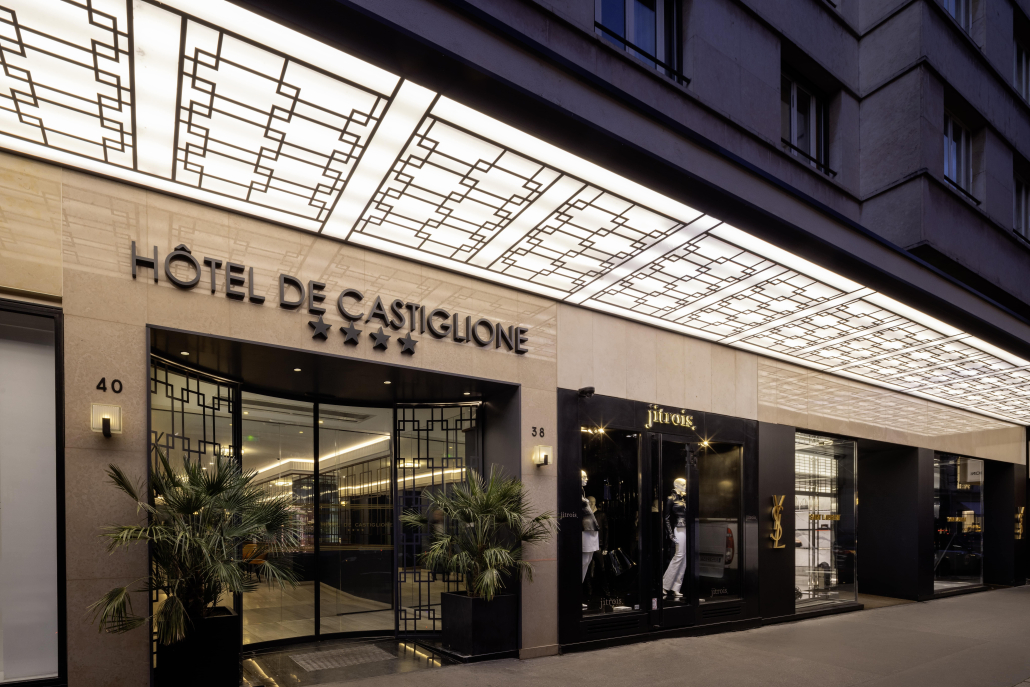
Hôtel de Castiglione, Paris 8th arrondissement – Outdoor wall lights no. 1151, Atelier Jean Perzel
That’s the power of a well-designed outdoor light fixture: not only does it illuminate, it also asserts an identity even before the door opens.
The lobby and circulation areas: light that guides the way
Once you cross the threshold, it’s the turn of the lobby and entrance hallways to take over. These transitional spaces have a specific mission: to guide without forcing, to envelop without suffocating.
At the Dinamo Hotel in Baku, the ceiling lights No. 165 ter punctuate the reception hallway with regularity and elegance. Their soft diffusion, characteristic of opaline glass crafted in the workshop, avoids any harsh contrast. The eye is naturally drawn inward. You walk forward, breathe in, and feel welcome.
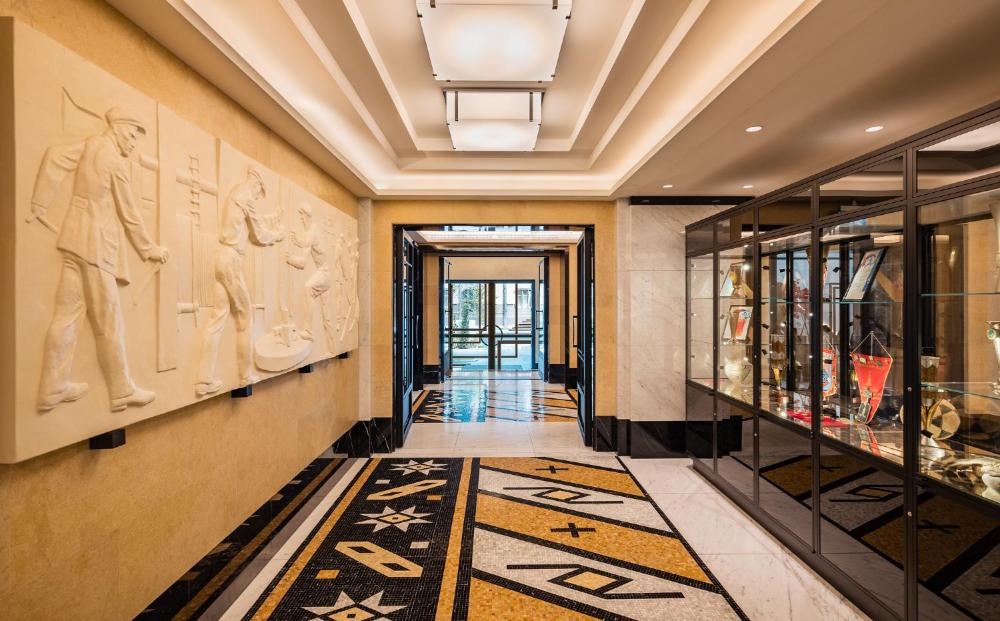
Dinamo Hotel, Baku – Ceiling lights no. 165 ter, Atelier Jean Perzel
This type of traffic lighting requires a delicate balance: bright enough to be reassuring, yet discreet enough not to be distracting. Lighting that is too powerful is tiring; lighting that is too dim creates an impression of neglect. The quality of the light distribution makes all the difference… and that is the key to successful hotel reception lighting.
Lounges and waiting areas: lighting that creates a welcoming atmosphere
After the first impression comes the time for installation. Reception rooms, waiting areas, rest areas adjacent to the lobby – these areas require a different kind of lighting: more intimate, more enveloping, conducive to relaxation.
Also at the Dinamo Hotel, the small lounges are equipped with ceiling lights no. 373. The result is striking: warm, even lighting that transforms these passageways into real living spaces. The volumes are highlighted, the materials breathe, and the atmosphere is calming.
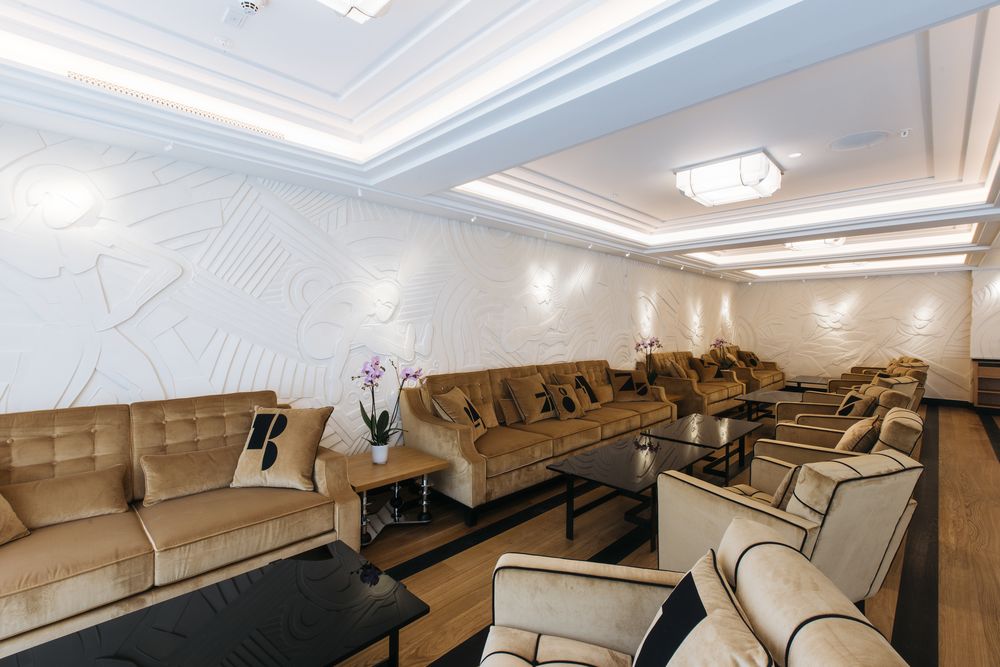
Dinamo Hotel, Baku – Ceiling lights No. 373, Atelier Jean Perzel
The same ceiling light no. 373 can be found at the Rheinhotel Schulz in Germany, this time in the bar adjacent to the reception area. In this context, the light plays an extension role: it creates continuity between the reception area and the first living space, suggesting that the quality of the place is confirmed with every step.
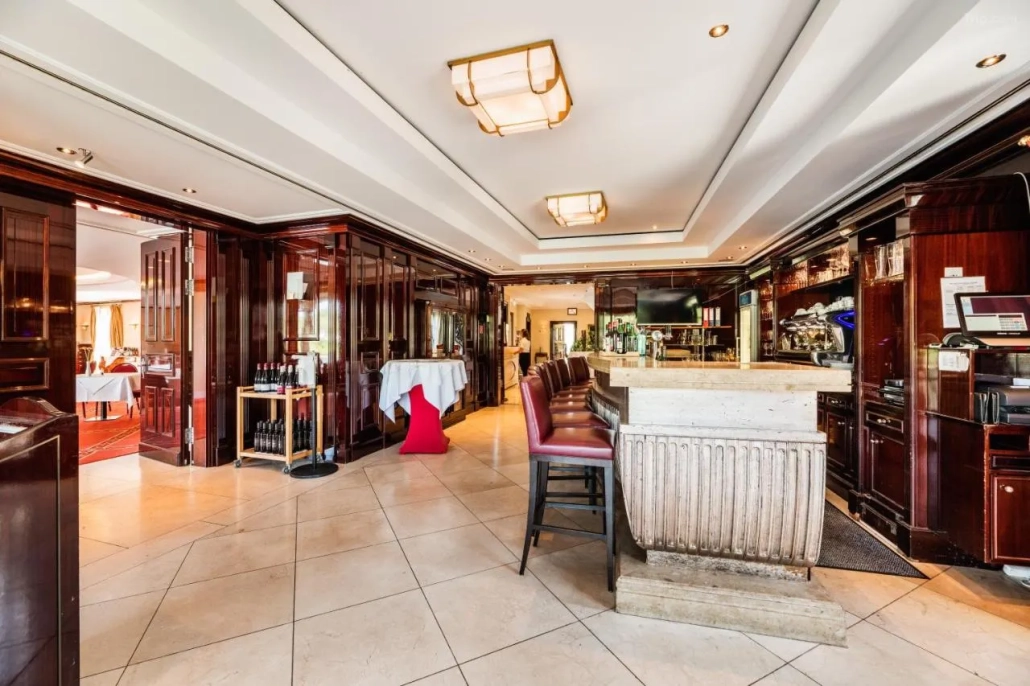
Rheinhotel Schulz, Germany – Plafonniers n°373, Atelier Jean Perzel
The reception desk: light at the heart of human connection
There is one specific point where light and hospitality come together in an almost symbolic way: the reception desk. This is where travelers first meet a member of the team. This is where the relationship begins.
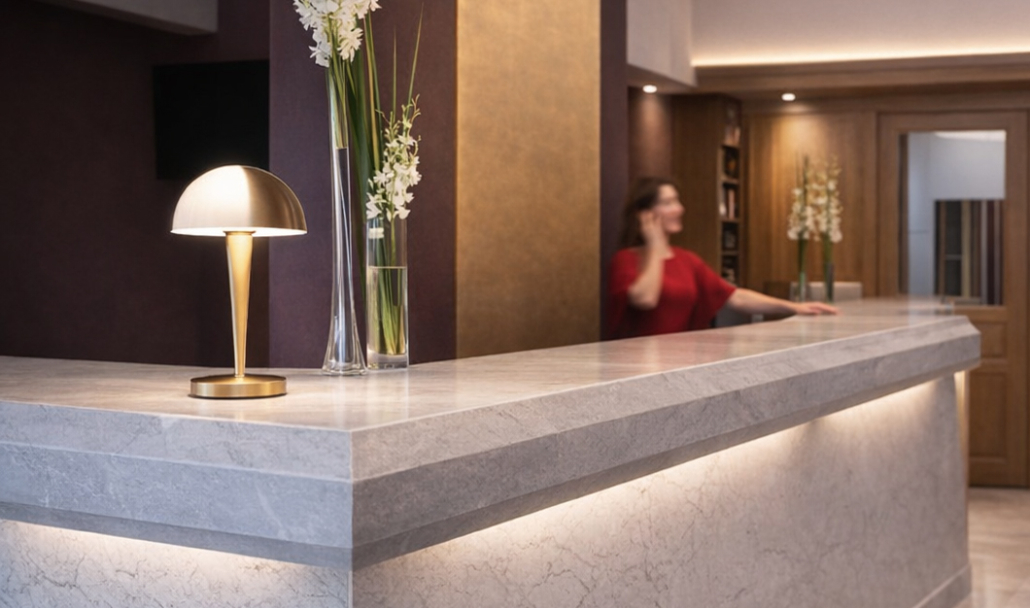
At the Hôtel Paris Neuilly, a No. 509 bis lamp with a brass finish sits proudly on the marble counter. Its presence is both functional and decorative. It provides light without glare, punctuating the space without cluttering it. Above all, it creates an immediate warmth – that golden halo that makes the moment of welcome more human, more personal.
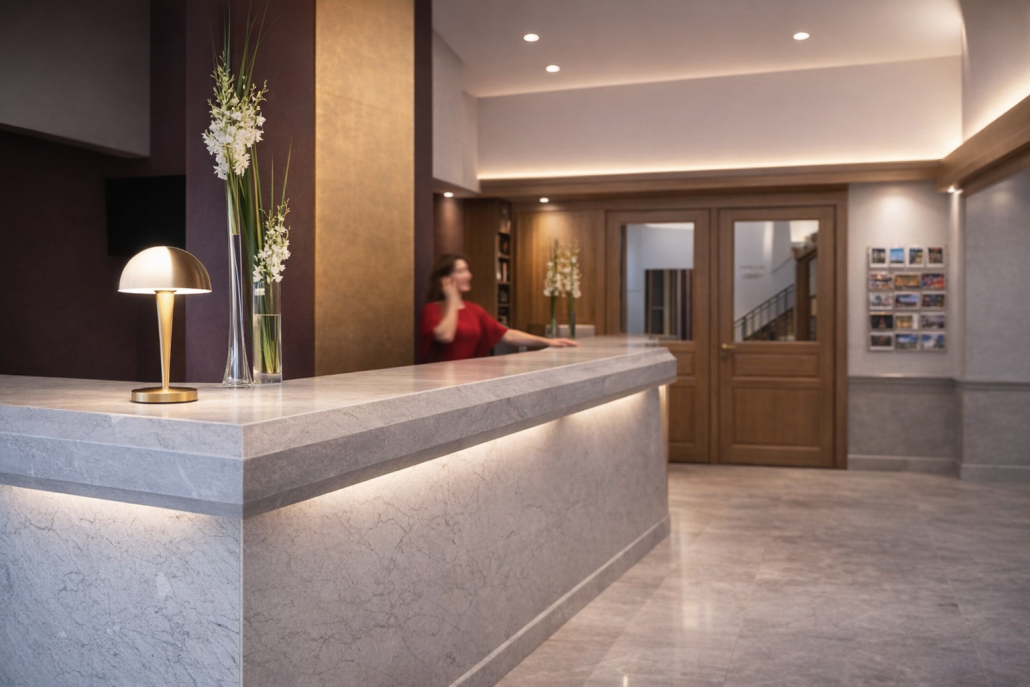
Hôtel Paris Neuilly – Lamp No. 509 bis, Atelier Jean Perzel
The 509 bis lamp was not chosen at random. Originally designed in 1928 for the Cité Universitaire in Paris, for nearly a century it has embodied the combination of functionality and understated elegance – precisely the qualities expected of an object placed at the heart of a reception area.
What lighting says about a hotel
Hotel reception lighting: a choice that matters
A boutique hotel is built on conscious choices. The choice of fabric, material, artwork hanging in the lobby – and the choice of lighting fixtures. These decisions are never neutral: they signal a standard, consistency, and vision.
Working with a workshop such as Jean Perzel means gaining access to a century of expertise in lighting in the world’s finest hotels, palaces, and prestigious establishments. It also means benefiting from a high degree of customization – finishes, dimensions, configurations – that allows each piece to be adapted to the constraints and identity of each establishment.
To learn more, check out our article dedicated to lighting in luxury hotels.
And to discover our entire collection, explore our lighting fixtures.